Has anyone gone through this yet? Because the fact that Mary didn’t get to be a bride on screen has been plaguing me for the last 24 hours.
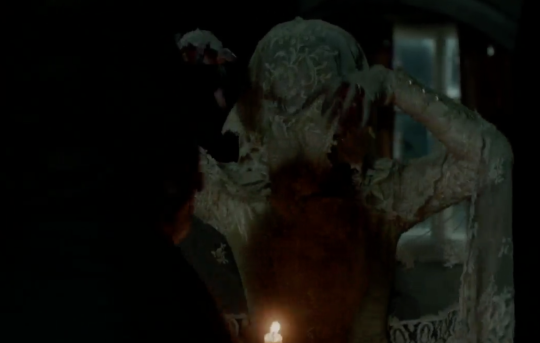
Sherlock has that moment at the end, before Moriarty raises the veil, where he’s mirroring that moment in His Last Vow.
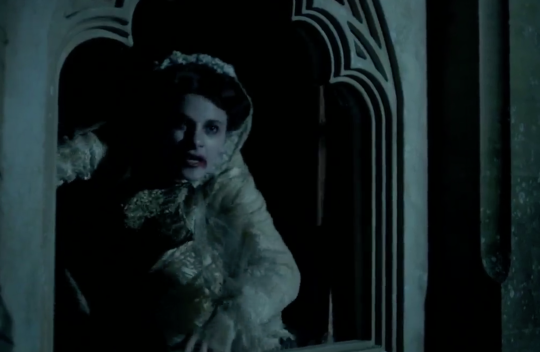
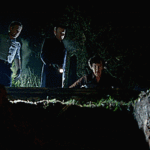
Mary is the only one of the women that we didn’t get to see as the bride–and we know Lady Carmichael didn’t kill her own husband because she was literally in the room with Sherlock when John saw the bride, yes? Sherlock assumes later that it was Molly who climbed out the window–but why couldn’t that have been Mary?
That particular bride even crops up scaring John in the editing when Sherlock’s “the women we have lied to, betrayed, ignored” line is delivered. John and the bride are on screen for “ignored.” Who has John been ignoring?
The fact that there was a “Miss me?” note on the corpse would support this theory, as well, if you’re of the belief that Mary is the “new” Moriarty. None of the other corpses had notes–why this one, if it wasn’t someone trying to send a message to Sherlock Holmes? (Like the Study in Pink suicides, there was only one note–and it was the one that started Sherlock on the path to Moriarty.)
So Sherlock is asking the Moriarty-bride, who has come specifically out to see him, why she engaged him in the case when she intended to commit the murder herself. He’s so sure it’s Lady C., but at the same time, he’s confused–he says it doesn’t make sense.
And the way he delivers this line is very similar to his delivery of the Lady Smallwood line in HLV. His reaction is similar, as well–he’s shocked. He says explicitly “It can’t be you.” He’s thrown the same way he was when Mary turned around and revealed herself as the person training a gun on Magnussen. Then that string of his mind palace starts to come undone and he “wakes up.”
But Sherlock’s subconscious is starting to put it together–it had to be Moriarty who committed the murder, but not Moriarty as Sherlock knows him.
Even when Sherlock starts to “wake up,” Moriarty’s line “You’re dreaming” is immediately said by Mary. Sherlock’s brain is connecting Mary to Moriarty–especially given the fact that we now know he was still in the mind palace when he heard Mary/Moriarty say “You’re dreaming.”
None of it makes sense to his brain because Moriarty is the “virus in the data.” He’s infiltrating in places where Sherlock’s brain seems too afraid to actually see the truth, the same way Sherlock saw Moriarty in Hound. Almost all the other episodes had direct parallels in this one, but Hound didn’t get one beyond the short mention at the beginning (”the dog one”) and the “once you’ve eliminated the impossible” bit with the ghost. But in Hound, Sherlock saw Moriarty in place of the scientist fellow whose name I can’t remember.
Here, he sees Moriarty in place of Mary.
And then, just like in Hound, he blinks it away and sees the person he’s meant to see. Sherlock “wakes up” and sees Mary.
I’m going to agonize over this for the next year, aren’t I?
I think you should be really proud of this, actually. Nicely done.
Yes, great point. Totally agree.
Also (and I have no spot to back myself up, so I could technically be wrong): I’m pretty sure everyone on the plane gets a mirrored line with their 1985 counterpart except Mary.
Sherlock has one, John has “morphine or cocaine?”, and Mycroft has “Did you make a list?”
Mary’s mirrored line is “You’re dreaming.” And it’s a mirror of Moriarty.
I know we are all on a “Mycroft is doomed” kick, but after thinking about the scene in which Mycroft and Sherlock are discussing their bet, I can’t help but wonder if this scene was actually all about Sherlock. We are told to focus on Mycroft and his overindulgence; John says that if Mycroft keeps this up that he will be dead in five years. Sherlock says three and then two, if Mycroft just indulges a little bit more.
And what has Sherlock been doing this entire time? Indulging in his habit. It’s possible this scene is nothing more than foreshadowing Mycroft’s untimely demise, but all I can see is Sherlock telling himself what he already knows: if he keeps this up, if he doesn’t stop taking drugs, he’s got two years at the most. In his mind palace, John (his heart and steadfast companion– always there when he needs him) and Mycroft (meddling, but ultimately always knows what Sherlock needs to do in time of crisis) tell him what he doesn’t want to hear or really acknowledge. It manifests as Mycroft going for one more pudding, but then the waiter pulls back the lid and it is revealed that it’s never just *one* more pudding. With Sherlock, it’s never just *one* more high. He can’t be satisfied with just one. He has to keep chasing the high.
What does it say, then, that mind palace!John can actively see “Mycroft’s” problem, but our real John keeps overlooking and pretending that Sherlock’s problem isn’t as bad as it actually is? Is it Sherlock wishing that John could see to the heart of the issue (after all, mind palace!John is so worried about “Mycroft’s” heart)? So much of the narrative of this show is about Sherlock’s heart, his sentiment, that I can’t read this scene as just being for laughs or a nod to what awaits Mycroft in series 4.
It’s an interesting echo of the mind palace scene from HLV; Sherlock actively seeks out Mycroft and John in that episode because he knows he is dying, but wants to live. In the special, he knows he is dying, but doesn’t want to hear it. He needs someone to see to the heart of the matter. He needs his doctor.
This also gives the whole “man out of time” a very different read.
So part of last night’s chit chat with @just-sort-of-happened and @hubblegleeflower involved talking about the dual nature of MP Mycroft. (Sorry guys I was too full of feels and cocktails to attribute properly; I know this observation about Mycroft wasn’t mine though.) There’s Mycroft the parody, the grotesque joke and manipulator, and soft, caring Mycroft.
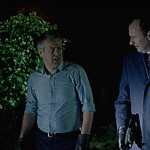
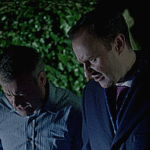
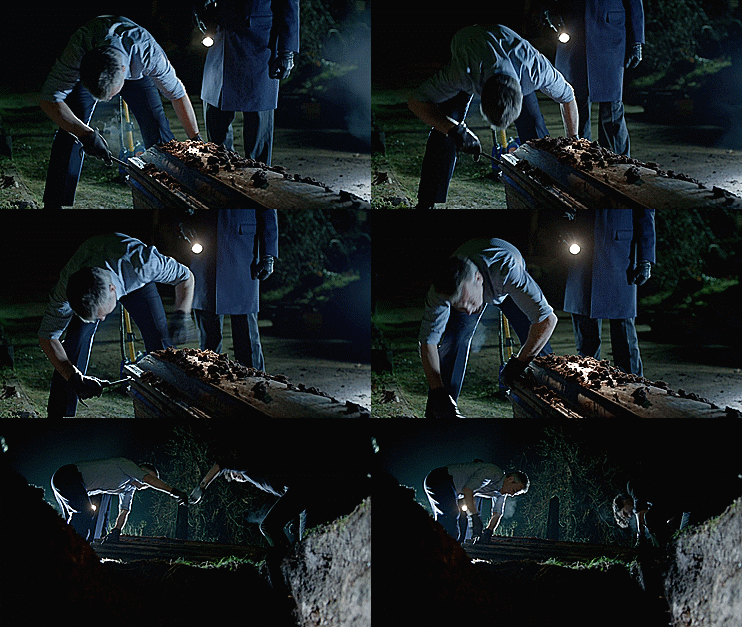
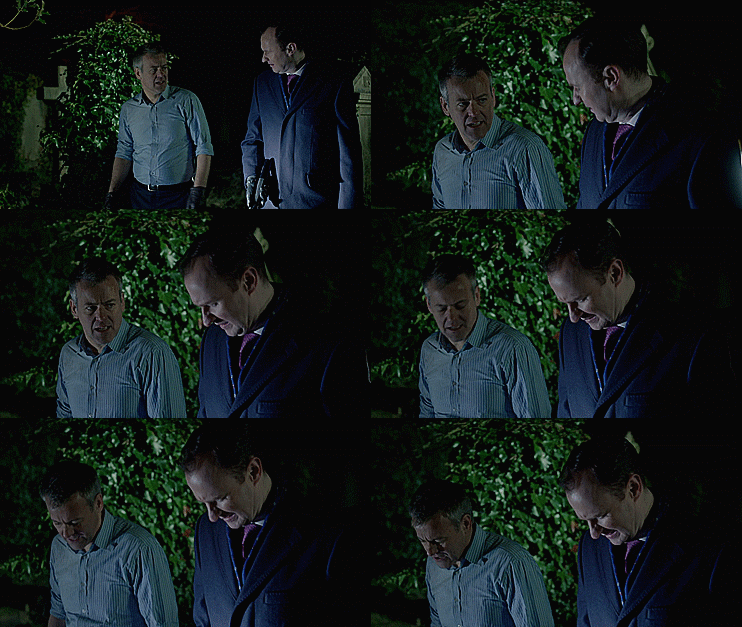
There are twins EVERYWHERE, y’all. Molly Hooper, almost-dude, and lady conspirator. Let’s talk about mutton chop Lestrade (I’m refraining from too much comment here, but I thought they were going out of their way to make him look frumpy) vs. grave digger Lestrade (smoking hot and manly). Sherlock himself is doubled, I mean we’ve all noticed this but
He’s sharp as a tack. He’s a zen meditator. He’s masterful and in control and not
1895 MP John is doubled too, and what’s more, he knows it. Cheekily so.
I’m not 100% sure where to go with this but twins are all over tab, and the lesson here is that everyone contends with more than one self.
Except Ms. Mary. Sure, she wears modern clothes in the modern scenes and Victorian garb in the Victorian scenes, but she’s the same monolithic Mary Sue in all of them, a virtual superhero with exceptional values and skills. Ridiculously developed skills. She hacks MI5 with a smartphone as deftly as she turns up with the solution to the Bride problem (ha!) at exactly the right moment.
So where is Mary’s twin?
But also
and
Hers is a monstrous doubling, in part because she’s paired with monstrous figures, but also because there’s a plethora of them. Mary is prolific in her mirrors. One breaks, but there are always more ready to hand.
Smarter heads than mine will have other places to go with this but twins are all over tab; twins of numerous kinds, doubles and doppelgangers and subconscious others. John Watson is always right, and maybe we’ll see a literal secret twin in the future, but I for one hope that we’ll continue to work at this metaphorical level, and continue to see some of the uncanny themes developed in tab play out in Series 4 and 5. Mary’s gonna keep ‘em guessing.
My husband is three people. Sherlock – not only is it sometimes twins, occasionally it’s triplets (or multiples, as in the case of the brides).
This talk of twins also made me think of, ‘the other one’, possibly being Sherlock’s twin.
Sherlock’s “of course” realization at the waterfall scene, when he realizes that MP!John isn’t oblivious like he originally thought is so precious for several reasons.
1. For the first time in a long time, he recognizes and fully appreciates MP!John’s (and, by extension, Real!John’s) intelligence and accepts MP!John as a teammate, an equal. So many of the missed opportunities and misunderstandings in the show come about because one of them tries to do something without the other. The recognition that John is worthy of inclusion in all plans is certainly a shift from earlier, when Sherlock disparages John for his intelligence.
2. He realizes that his MP can now be a safe haven for his fantasies because MP!John has acknowledged that it is not reality. John’s inquiry about the “other me in the other place” more explicitly displays that, but the storyteller line was proof enough.
3. Notice how MP!John reacts to Sherlock’s big secret. He’s not disappointed or angry or passive-aggressive. He’s understanding and curious. I think that this is indicative of the way that Sherlock wants John to react when he tells him the truth about his romantic/sexual history and orientation, but he’s scared that Real!John won’t understand and that he will leave. This scenario is one that I often reenact in my head with crushes; I play out all the scenarios I can think of, saving the most positive one for last.
4. MP!John is capable of letting Sherlock go back to the real world, even encourages it with the “time to wake up” comment. I think that Sherlock probably resisted indulging himself in fantasies of himself and John together because he was afraid that he would never want to return to the real world with Real!John. He tests that theory by jumping Inception-style over the edge. What does MP!John do? He lets him go.
In conclusion, this scene does a lot to reaffirm TJLC, but it does more than that. It breaks down barriers in Sherlock’s mind, barriers that he had set in place to protect himself. He realizes that he doesn’t need those barriers anymore because MP!John will protect him…and perhaps, Real!John will too.
I am so glad his subconscious knows this. And get your f-in act together, John. Sorry. I don’t think tough love works. I’ve seen people destroyed by it. And that seems to be John’s mantra here.
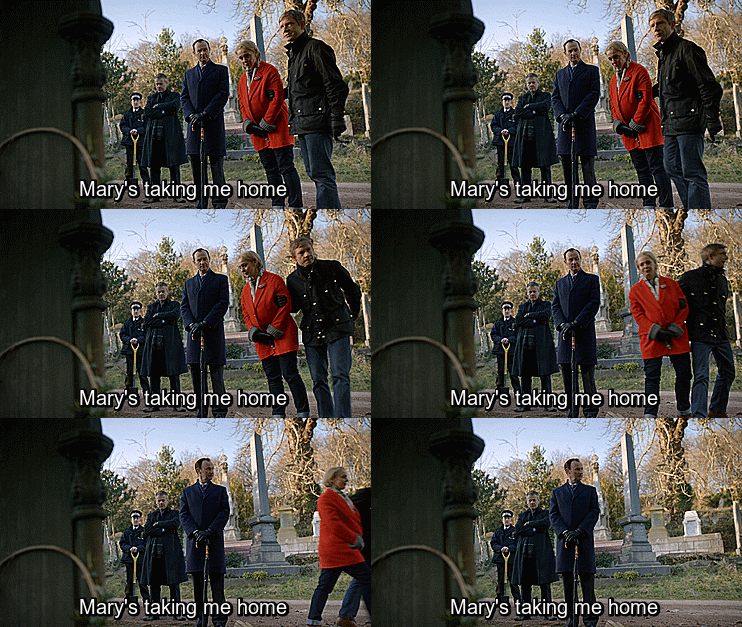
But this was in Sherlock’s mind-palace. So, yes, Sherlock knows that Greg and Mycroft will stand by him – but he still thinks that John will get angry and leave.
Real John does stand by him – in fact real Mycroft relies on him to do so: “Look after him, please.”
You are right, of course. But I also think if you haven’t made it clear you will stand by someone in such a way that they *know* it…that is sort of an issue still. Mycroft shouldn’t have to ask. But then again, that’s just me being my usual Sherlock-centric self. Sherlock feels this way, and it’s not without reason. And yes, Mary takes him away, but he was ready to leave on his own using rhetoric I do associate with giving up on addicts when they need you most. I think this is a John issue. A deep John family issue where Sherlock thinks John will ditch him as he did his sister.
I think that, in reality, John would be there for Sherlock if Sherlock asked him to be. But Sherlock believes that John would leave him because he saw John leave him when he got married to Mary – we know that they hadn’t seen one another in awhile or been in communication in awhile at the start of HLV. So, in that sense, John did distance himself from Sherlock. But John has reason for distancing himself from Sherlock too. Sherlock left John too. John suffered indescribably when Sherlock “died”. And he left John by more than just faking dead, he left John by allowing John to believe he was dead but letting others know that he was not, including Mycroft, his parents, and Molly, someone who John would not have thought Sherlock to be close to, and certainly not closer than he saw himself to Sherlock. John would feel really betrayed by this. John already had trust issues, and this experience would only heighten them and cause himself to distance himself from Sherlock. We as an audience know why Sherlock “died” and didn’t tell John his plans – we know that, ultimately, Sherlock did all of this for John – but I don’t think that John really fully understands that yet. I don’t think Sherlock and him have properly talked about that yet. They both have communication issues.
Yes, this is all true. And I think Sherlock is well aware of how he contributed to this emotional mess. We’ve gone round this as a fandom, back when we discussed forgiveness for the Fall, and there’s no need for me to go on, accept to acknowledge that I generally do see things more from Sherlock’s POV.
My main point was to confirm that, through this, *we know Sherlock sees Lestrade and Mycroft as being there for him through it all, in ways John isn’t…and not just due to Mary, because in this scene John was ready to leave before Mary decided to take him away*. We have greater insight about what Sherlock has thought about John being there for him or not, and this perception stays with him right up until the waterfall. If John is truly that supportive, Sherlock doesn’t feel it. Yet. Yup, my personal issues surrounding being there for someone without them ever having to ask. Intuiting. That’s what good art does. Makes you think about this stuff.
Hmm. I love your posts. Thanks so much for them. 🙂 I love unpacking and thinking through everything, and your thoughtful posts definitely inspire me to do so.
Yes, Lestrade and Mycroft have helped Sherlock through some of the toughest moments of his life – dealing with drug addiction – and John hasn’t, so it totally makes sense that Sherlock has confidence they will be there for him and that they are there for him in this scene. In fact, John has turned away from Sherlock – in a sense – during this newest difficult moment of Sherlock’s life, by getting married and then throwing himself seemingly completely into his married life (as I already mentioned, we know at the start of HLV that they have been out of contact after John’s marriage). Hence this is perhaps why Mary takes John away in this scene, and why John is willing to go with her even before she says she is taking him away; that’s where Sherlock has seen and felt John’s support and loyalty has gone – to Mary and the marriage. I know we have already discussed John and the Fall and the emotional mess that Sherlock has caused ad nauseam, but I did bring it up again because I still think it relates very directly to why Sherlock doesn’t feel John’s support yet.